Crossing the Line: Postcolonial and Queer Frameworks for Theorizing Cultural Boundaries
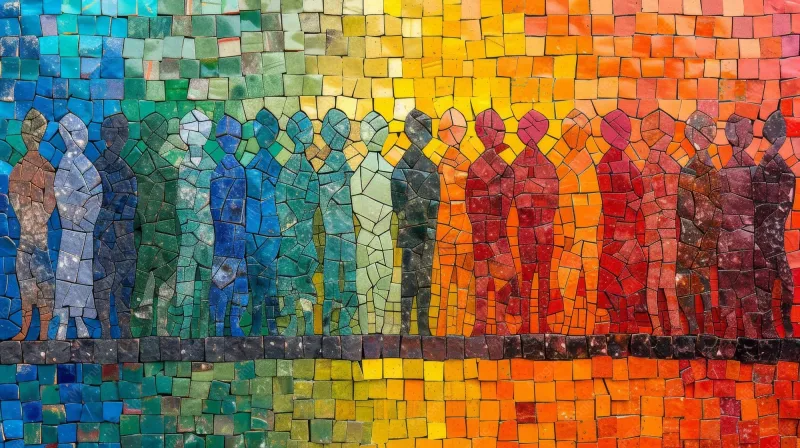
Photo: cultural border abstract art mosaic identity diverse hands, via img.freepik.com
Few debates in contemporary American cultural life generate more heat with less theoretical precision than those surrounding cultural appropriation. Whether the flashpoint is a fashion house's use of Indigenous beadwork motifs, a non-Black artist performing hip-hop, or a film studio casting against ethnic type, the public discourse tends to oscillate between two equally unsatisfying positions: a liberal pluralism that celebrates all cultural mixing as cosmopolitan enrichment, and a protective essentialism that assigns cultural practices to bounded communities and polices unauthorized access. Critical theory, drawing on postcolonial, border studies, and queer traditions, offers a third path—one that takes seriously both the violence of cultural extraction and the complexity of living, hybrid cultural formations.
Gloria Anzaldúa and the Theorization of the Borderlands
Any serious engagement with the politics of cultural boundary-crossing must reckon with Gloria Anzaldúa's Borderlands/La Frontera: The New Mestiza (1987), a text that remains foundational to border studies and Chicana feminist theory. Anzaldúa's conceptualization of the borderlands is not merely geographic—it describes a psychic, sexual, and cultural space inhabited by those who exist between dominant categories, who are claimed fully by no single identity formation and who therefore develop what she calls a "mestiza consciousness."
This consciousness is not celebrated as a form of postmodern free play. It is described as painful, disorienting, and forged under conditions of colonial violence and economic dispossession. The border, for Anzaldúa, is a wound as much as a site of creative possibility. This dual character is theoretically crucial: it prevents us from romanticizing liminality as inherently liberatory while also refusing to treat cultural mixture as inherently contaminating. What matters is the power differential under which crossing occurs.
Homi Bhabha, Hybridity, and the Ambivalence of Colonial Culture
Homi Bhabha's postcolonial framework, developed across essays collected in The Location of Culture (1994), provides complementary analytical tools. Bhabha's concept of hybridity describes the cultural forms that emerge in the space between colonizer and colonized—forms that are neither purely one nor the other and that carry within them an ambivalence that disrupts the authority of colonial discourse. Crucially, Bhabha argues that hybridity is not a voluntary multicultural achievement but a structural feature of colonial encounter.
The implications for contemporary debates are significant. When critics of appropriation appeal to cultural purity or authenticity, they risk reproducing a logic of bounded, static cultural identity that postcolonial theory has systematically dismantled. Cultures are not sealed archives; they have always been produced through contact, conflict, and exchange. The relevant critical question is not whether crossing occurs—it inevitably does—but under what conditions, with what asymmetries of power, and to whose material and symbolic benefit.
Edgework and the Politics of Transgression
The concept of edgework, borrowed from sociologist Stephen Lyng's analysis of risk-taking behavior and adapted within cultural criticism, describes practices that deliberately inhabit or traverse social boundaries. In cultural contexts, edgework names the transgressive artistic gesture: the white rapper, the non-Native artist painting ceremonial imagery, the cisgender actor playing a trans role. Such acts are often defended within a liberal humanist framework as expressions of imaginative empathy or universal artistic freedom.
Queer theory complicates this defense in productive ways. Judith Butler's analysis of performativity demonstrates that identity categories are not prior to their enactment but are constituted through repeated citation of normative conventions. This means that transgressive performances do not simply violate pre-existing identities; they participate in the ongoing social production of those identities. The question of who gets to perform what, under what conditions of recognition and reward, is therefore not merely ethical but ontological—it concerns the social construction of the very categories being crossed.
José Esteban Muñoz's concept of disidentification, developed in Disidentifications: Queers of Color and the Performance of Politics (1999), adds further nuance. Muñoz describes a mode of cultural engagement that neither assimilates to dominant cultural forms nor refuses them outright, but works on and against them simultaneously. This framework is particularly useful for analyzing artists of color who engage with dominant cultural traditions—neither simply reproducing them nor standing outside them, but transforming them through a practice of strategic inhabitation.
The Extractive Logic of Aesthetic Colonialism
What distinguishes legitimate cultural exchange from exploitative extraction? Critical race theorists and postcolonial scholars have pointed consistently to the role of economic and institutional power. When elements of a marginalized culture are adopted by members of a dominant group—stripped of their social context, repackaged for mainstream consumption, and made profitable for parties who bear none of the stigma or risk originally attached to those practices—the dynamic is better described as aesthetic colonialism than as cultural exchange.
This is not a hypothetical scenario. The history of American popular music is substantially a history of Black artistic innovation being appropriated, rebranded, and sold by white artists and white-owned record labels to white audiences, while Black originators were denied comparable commercial access. The blues, rock and roll, and hip-hop each followed recognizable versions of this pattern. The language of "influence" and "inspiration" has functioned ideologically to naturalize what was in fact a structured transfer of cultural and economic value.
Patrick Wolfe's concept of the "logic of elimination" in settler colonialism is relevant here as well: Indigenous cultural forms have historically been suppressed in their living communities while simultaneously being preserved, romanticized, and commodified by settler institutions. The museum display of sacred objects, the sports team mascot, the fashion house's "tribal" collection—these represent not cultural appreciation but a form of necropolitical aesthetics in which living communities are erased while their symbolic residue is extracted for settler profit.
Navigating the Terrain: A Conceptual Toolkit
For students and scholars approaching these debates, several theoretical distinctions prove consistently useful. First, the distinction between structural and individual analysis: appropriation debates that focus exclusively on individual intent miss the systemic patterns through which cultural value flows along established power hierarchies. Second, the distinction between static and dynamic conceptions of culture: appeals to authenticity often presuppose an impossible cultural purity that erases the historical processes through which all traditions are constituted. Third, the distinction between representation and redistribution: increased visibility of marginalized cultures within dominant media does not automatically translate into material benefit for the communities from which those cultures emerge.
Finally, Anzaldúa's borderlands framework reminds us that those who actually inhabit cultural boundaries—biracial individuals, immigrants, queer people of color, diaspora communities—are rarely the ones celebrated for their liminality. The border is most often theorized from a comfortable distance by those for whom crossing remains a choice rather than a condition of existence. Any critical framework adequate to these questions must keep that asymmetry in view.